

Introduction
This Planning Insight reviews how planning authorities have responded to the NPF Implementation: Housing Growth Requirements Guidelines for Planning Authorities (July 2025) (Housing Growth Guidelines hereafter) guidelines.
The Housing Growth Guidelines were published to interpret the national housing growth requirements identified in the Revised National Planning Framework for implementation through development plans. The Guidelines set out updated housing growth requirements to 2040 and requires planning authorities to incorporate the requirements of guidelines through the variation of respective adopted development plans. Planning authorities should review the adequacy of existing zoned land to cater for the Housing Growth Requirements and the potential for up to 50% ‘additional provision’, with the zoning of alternative lands to meet any shortfall in the short to medium term. It also recommends planning authorities should consider as an immediate priority the suitability of lands for development over a 12 year plus period (to encompass the remaining period of the current adopted plan and the lifespan of the new 10-year development plan).

Almost a year on since the publication of the Housing Growth Guidelines, we examine the development plan variations to date (as of 15th of June 2026), with more detailed focus on the counties within the Greater Dublin Area, particularly the extent to which the revised housing targets have been incorporated, additional zoned land, and identify emerging trends, inconsistencies, and key risks for housing delivery.
NATIONAL OVERVIEW
- Of the 31 Planning Authorities (PAs), 29 have commenced development plan variations, with 2 yet to publish their proposed variation.
- Majority of Proposed Variation Consultations commenced in Nov-Dec 2025 and Q1 2026.
- 14 no. PAs variations have been formally adopted.
- 6 no. PAs are currently at the Proposed Material Alterations stage.
- 7 no. PAs undertook an innovative approach to include a ‘Call for Sites’ consultation, to identify Tier 1 serviced land banks, in advance of, or in one case alongside, the formal variation process.
KEY FINDINGS AND RISKS FOR HOUSING DELIVERY
- Inconsistency in approach and limited early engagement with landowners.
- In some cases zoning additional land has been deferred to future Area/Settlement Plans or Development Plan Reviews.
- Over-reliance on long-term delivery sites requiring area plans and/or significant infrastructure, which will delay delivery to post 2030, with less focus on short-term delivery in the remaining plan period.
- Additional risks due to potential delays to plan-making for 10-year Development Plans.
- There is a need for a clear and consistent plan-led framework.
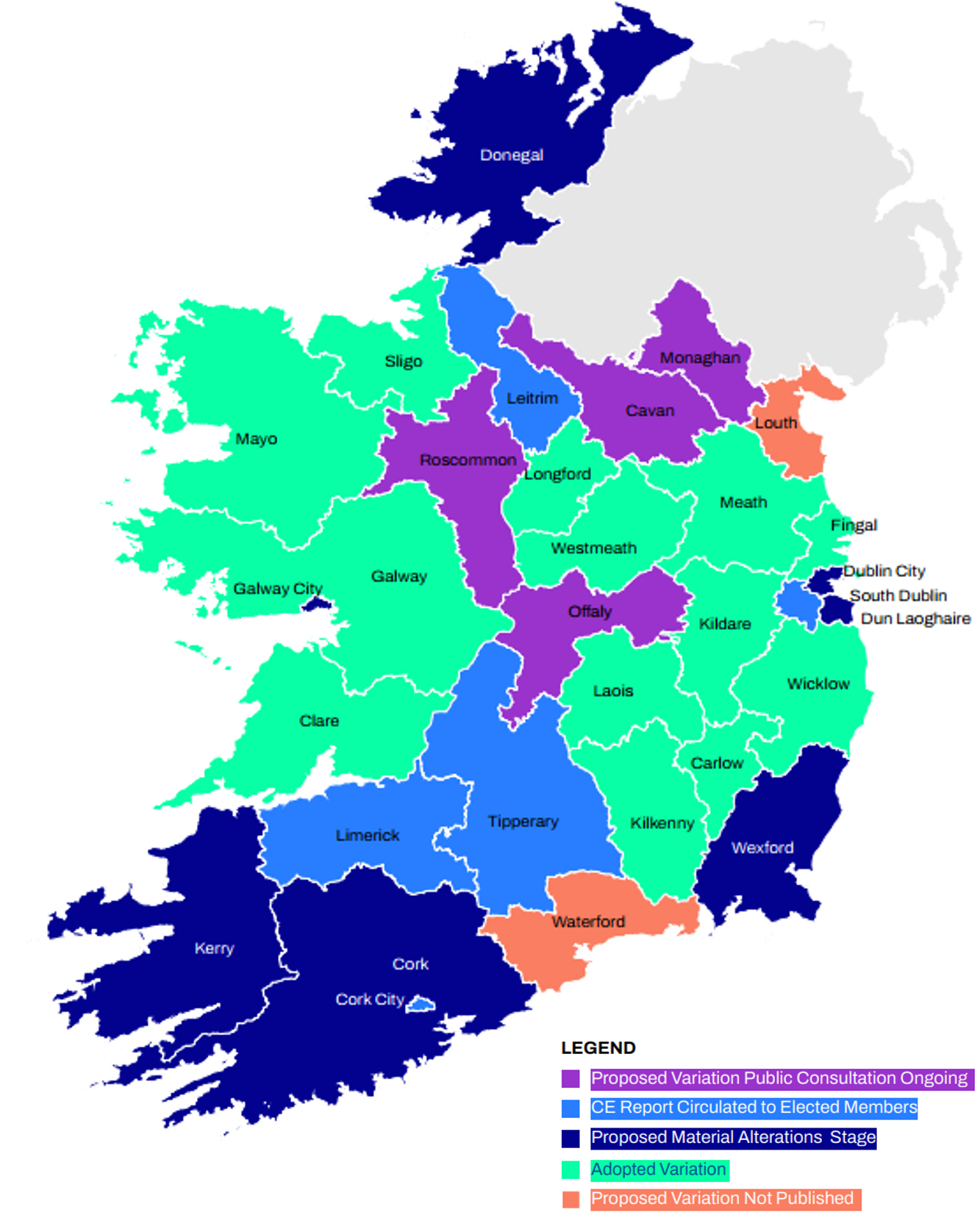

FOCUSED REVIEW – DUBLIN, WICKLOW AND KILDARE PLANNING AUTHORITIES
Housing Targets and 50% Additional Headroom
- All planning authorities are seeking to apply the annual housing targets set out in the Guidelines. Notably, some authorities have adjusted their remaining housing requirements to reflect the number of completions already delivered during the plan period.
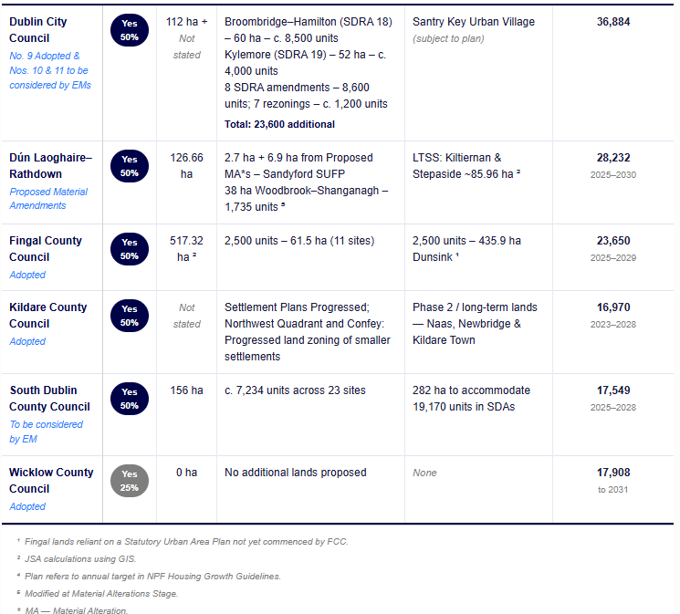
- The majority have applied the full 50% additional provision and incorporated as part of the housing target (e.g. South Dublin, Fingal, Dún Laoghaire–Rathdown and Kildare County Councils).
- Wicklow County Council state the new targets in their Proposed Variation exceed the housing requirement by 25%, on the basis that existing zoned land already exceeds the revised housing growth requirement by approximately 70%.
Additional Zoning for Residential Development
- Dún Laoghaire–Rathdown County Council Proposed Variation No. 1 identified a shortfall of c. 2,043 no. units against the Housing Growth Requirements and proposed to zone c. 40.7 ha in the short term, with a further c. 86 ha identified as longer-term strategic reserve (LTSS) in the Kiltiernan–Stepaside area. The Proposed Variation is now at the Proposed Material Alterations stage, with the public consultation running until the 26th of June 2026. As part of the Proposed Material Alterations, a number of additional lands are proposed for rezoning for residential development, along with a reduction in a proposed LTSS.
- Dublin City Council have 3 no. Proposed Variations to date of relevance to the NPF Implementation Guidelines (nos. 9, 10 and 11) with the response concentrated on Strategic Development and Regeneration Areas and the conversion of underutilised employment lands, reflecting constrained greenfield availability within the city. Key sites at Broombridge–Hamilton (60 ha, c. 8,500 units – Variation No. 9 now adopted) and Kylemore (52 ha, c. 4,000-5,300 units – Proposed Variation No. 10, currently at Proposed Material Alterations Stage), alongside revised SDRA targets and industrial land rezoning (c. 9,800 units – Proposed Variation No. 11), collectively provide for an increase of c. 23,600 units, positioning the city’s strategy firmly around regeneration and urban intensification.
- Fingal County Council adopted Variation No. 1 in March 2026 which identified a shortfall of residential zoned land for c. 4,600 units and responded through the zoning of 11 no. short-term sites for residential development (61.5 ha, c. 2,500 units) across north Dublin, and the partial bring-forward of the Dunsink lands (c. 436 ha, varied from Long Term Strategic Reserve to be advanced through an Urban Area Plan), with only a limited portion proposed for near-term activation.
- Kildare County Council adopted Variation No. 3, which provided for an additional housing growth requirement of c. 4,133 dwellings through the activation of Phase 2 lands in Naas, Newbridge and Kildare Town, additional housing growth to other settlements, with the identification of sites to be undertaken in forthcoming new Settlement Plans (e.g. Sallins, Monasterevin, Kilcock, Athy and Celbridge), and progressing strategic sites in the short term, with potential for long term Urban Development Zones (Northwest Quadrant, Naas, Maynooth West, and Confey, Leixlip). At the Proposed Material Alterations Stage a number of additional/amended zonings for residential development were also identified in smaller settlements and subsequently adopted.
- South Dublin County Council undertook a Call for Sites which informed the Proposed Variation No. 2 process. The Proposed Variation identified 23 no. sites for residential development (c. 156 ha, c. 7,324 units), with a further 282 ha designated as long-term strategic reserve beyond 2040. Variation No. 2 has recently concluded public consultation and the Chief Executive’s Report is with the Elected Members for their consideration.
- Wicklow County Council adopted Variation No. 5 and identified a new housing target of 17,908 no. units for 2025-2031. WCC state there is 401 ha of zoned and serviced land up to 2031 and that the Variation did not relate to the potential zoning of new lands, with a separate ‘Call for Sites’ process undertaken for expression of interest from landowners for the future potential zoning. WCC acknowledge that the quantum of zoned land would not be sufficient to meet longer term housing requirements up to 2040 and it is intended that these longer term needs will be addressed via a further variation or via integration into the next County Development Plan.

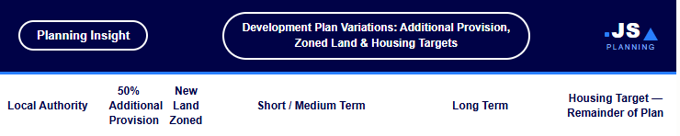
DEVELOPMENT PLAN VARIATIONS: ADDITIONAL PROVISION, ZONED LAND AND HOUSING TARGETS
EMERGING TRENDS, INCONSISTENCIES, AND KEY RISKS FOR HOUSING DELIVERY
The new national approach to housing requirements and zoning, as articulated in the Housing Growth Guidelines is welcomed, building on the revised National Planning Framework (NPF). In particular, the emphasis on planning authorities bringing forward timely variations to development plans, to incorporate increased housing requirements and associated zoning needs, including up to 50% headroom, represents a necessary and positive shift in policy.
Inconsistency in Approach and Limited Early Engagement
- It is clear from the progress to date that the variations have not come forward in as timely a manner as originally anticipated.
- In addition, a key concern is the limited early engagement undertaken by the vast majority of Planning Authorities prior to publishing variations.
- Within the current statutory / legislative provisions, there is typically no meaningful pre-draft consultation with landowners, infrastructure providers, or the development sector in advance of draft variations being placed on public display.
- The current legislation also limits the consideration of zoning at pre-draft stage in the preparation of new development plans, a constraint that should be revisited to enable more informed and effective plan-making.
- As a result, variations are often prepared based on incomplete information regarding land availability, suitability, and deliverability, particularly in the short term.
- This limits the options available to planning authorities and the ability of landowners to demonstrate the planning merits of their lands and undermines confidence in the plan-led system, and the key point of activating lands for much needed housing.
- This variability has implications for plan consistency and may lead to uneven development management outcomes across regions. While there are positive examples, such as the “Call for Sites” approach adopted by certain authorities in advance of the proposed variations, including South Dublin County Council, this is not applied consistently.
- While most authorities have incorporated revised housing targets, approaches to zoning, site identification, and additional provision vary significantly.
- Some authorities have clearly identified lands sufficient to accommodate both baseline housing requirements and the 50% additional provision, including a distinction between short- and longer-term development opportunities. Others have adopted a more generalised or deferred approach, with limited Settlement Capacity Audits, relying on future zoning or land activation measures.
Absence of Zoning in Certain Variations
- A related concern is that some planning authorities have introduced variations to increase housing requirements without zoning additional land to support delivery. Instead, zoning decisions are deferred to a later stage in the plan-making process.
- There is an element of uncertainty in some cases on zoned land identified to meet housing targets within the plan period, where the sites require area plans and/or significant infrastructure, which will delay delivery to post 2030.
- This approach is problematic, as the need for zoned and serviced land is immediate, particularly in the context of increased housing targets.
- It also creates difficulties in areas where settlements currently lack statutory land use zoning objectives due to the lapsing of Local Area Plans, as has been noted in the assessment of planning applications in some counties.
- The variation process represents a critical opportunity to address such gaps in the plan-led system. Where settlements are operating without statutory zoning, targeted and timely follow-up variations should be progressed to reinstate zoning clarity and support housing delivery.
Risks Arising from Delays to Plan-Making for 10-year Development Plans
- There is also concern regarding provisions in the Planning and Development (Amendment) (No. 2) Bill, published in January, which would allow planning authorities to extend the preparation of new 10-year development plans by up to 30 months.
- Such delays could have significant unintended consequences. Many development plans are already at, or approaching, the end of their effective lifespan.
- While extensions may maintain a statutory framework, the underlying housing targets and zoning capacity may be outdated and insufficient to meet needs over the extended period.
- Without further variations, there is a risk of proliferation of under-zoning at a time when housing delivery needs to accelerate.
- In practical terms, delays of up to two and a half years could slow housing supply during a critical delivery window, undermining the objectives of national housing policy.

CONCLUSION
Overall, while substantial progress has been made in advancing development plan variations in response to the NPF Implementation Guidelines, it is not clear to date how effective the variations will be in meeting the housing growth requirements. Differences in how planning authorities are interpreting housing targets, applying headroom, and identifying zoned land highlight a lack of consistency in translating national policy into practice.
While the statutory process itself is functioning as intended, the effectiveness of outcomes will depend on greater alignment in approach, stronger evidence-based zoning decisions, and more proactive engagement at earlier stages of plan-making. Ensuring that sufficient, deliverable land is brought forward in a timely and coordinated manner will be critical if the objectives of the Guidelines, and wider national housing targets, are to be realised.
The Need for a Clear, Plan-Led and Proactive Framework
Ultimately, the focus should be on establishing clear, consistent, and proactive plan-led frameworks as early as possible. This includes:
- Zoning sufficient and suitable land to meet at least 12 years of housing demand (to encompass the remaining period of the current adopted plan and the lifespan of the new 10-year development plan), plus appropriate headroom (including the 50% additional provision),
- Ensuring that zoning is supported by realistic assumptions regarding site availability, infrastructure provision and deliverability (informed through engagement with landowners), and
- Applying a consistent and transparent approach across planning authorities, in particular including early engagement with developers / landowners through a ‘call for sites’ process.
A more coordinated, evidence-based, and front-loaded approach to zoning will be essential to restoring confidence in the planning system and ensuring that housing delivery aligns with national policy objectives.

If you would like to discuss this insight in more detail, please contact us by clicking the button below. A downloadable copy of this insight is available if you click here.